


Introduction: Why SEO and PPC Should Never Be Treated as Separate Worlds
In digital marketing, one of the most persistent misconceptions is that SEO (Search Engine Optimisation) and PPC (Pay-Per-Click advertising) are competing strategies. Businesses often treat them as an “either/or” decision, allocating budget and attention to one while sidelining the other.
In reality, this separation is artificial—and often expensive.
SEO and PPC are two sides of the same search visibility strategy. One builds long-term authority and organic traffic, while the other delivers immediate visibility and precise targeting. When used together, they don’t just coexist—they amplify each other’s performance.
A well-balanced search strategy ensures you are visible at every stage of the customer journey, from initial discovery to final conversion.
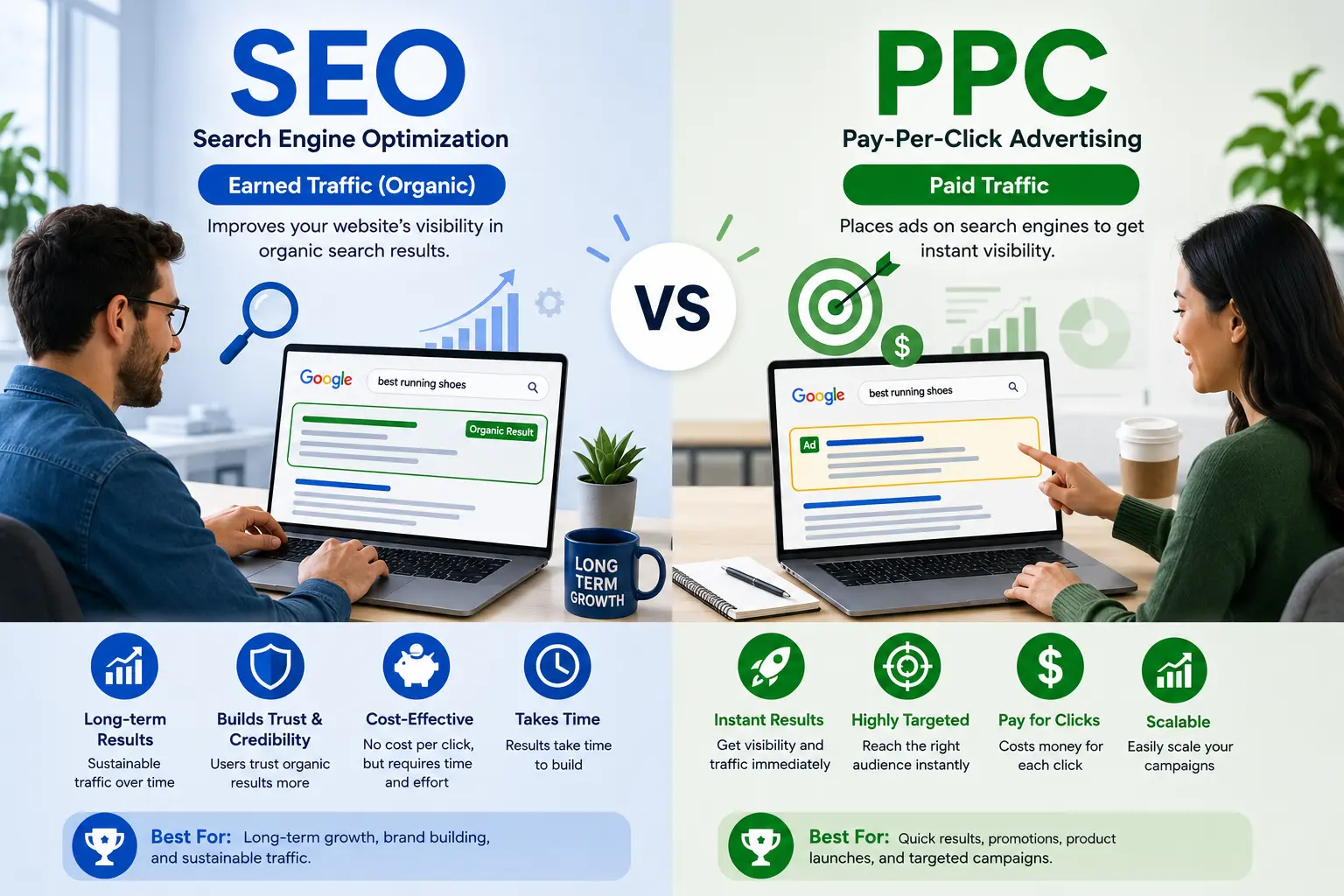
SEO vs PPC: A Clear Breakdown of How Each Channel Works
What is SEO (Search Engine Optimisation)?
SEO is the process of improving your website so it appears in organic search results without paying for each click. It focuses on increasing visibility, credibility and relevance in the eyes of search engines like Google.
A strong SEO strategy includes:
- Technical optimisation (site speed, crawlability, indexing)
- On-page optimisation (keywords, headings, internal linking)
- High-quality content creation that answers user intent
- Off-page authority building through backlinks and brand signals
- Ongoing optimisation based on search behaviour and analytics
SEO is not instant. It is a long-term investment that compounds over time, building sustainable traffic and brand trust.
What is PPC (Pay-Per-Click Advertising)?
PPC is a paid search model where businesses bid on keywords to appear at the top of search engine results pages. You are charged only when a user clicks your ad.
A strong PPC strategy involves:
- Keyword targeting based on intent and commercial value
- Ad copy creation and A/B testing
- Budget management and bidding strategies
- Landing page optimisation for conversions
- Continuous performance monitoring and refinement
Unlike SEO, PPC delivers immediate visibility, making it especially valuable for new campaigns, promotions or highly competitive markets.
SEO vs PPC: Key Differences That Matter in Practice
| Aspect | SEO | PPC |
| Cost Model | Investment in content and optimisation | Pay for each click |
| Speed of Results | Gradual, long-term growth | Immediate traffic |
| Trust & Credibility | Higher organic trust perception | Seen as sponsored content |
| Sustainability | Builds long-term asset value | Stops when spending stops |
| Data Feedback | Slower trend-based insights | Real-time performance data |
While these differences are important, they should not be interpreted as reasons to choose one over the other. Instead, they highlight how each channel plays a different but complementary role.
The Biggest Mistake Businesses Make: The “SEO vs PPC” Mindset
One of the most common strategic errors in digital marketing is treating SEO and PPC as competing investments.
This leads to fragmented decision-making, where:
- SEO is seen as “free traffic” but underfunded
- PPC is treated as a short-term fix rather than a strategic tool
- Data is siloed, preventing meaningful insights
- Opportunities for optimisation across channels are missed
The result is inefficiency—higher costs, weaker performance and missed growth potential.
A smarter approach is to treat both channels as part of one unified search strategy.
When SEO and PPC Should Be Prioritised
The right balance depends on business objectives, timing and market conditions.
When PPC should take priority:
- Launching a new product or service
- Running time-sensitive campaigns
- Entering highly competitive markets
- Needing immediate lead generation or sales
PPC provides instant visibility and control, making it ideal for short-term growth goals.
When SEO should take priority:
- Building long-term brand authority
- Reducing cost per acquisition over time
- Targeting informational or high-intent organic search traffic
- Competing in markets with high CPC costs
SEO delivers compounding returns, making it essential for sustainable growth.
How SEO and PPC Work Together to Improve Performance
When properly aligned, SEO and PPC create a feedback loop that strengthens both channels.
1. Shared Keyword Intelligence
PPC campaigns provide immediate data on which keywords convert best. This insight can guide SEO content creation, ensuring effort is focused on high-value search terms.
2. Improved Messaging Through Testing
PPC allows rapid testing of headlines, descriptions and calls to action. The best-performing messaging can then be applied to:
- SEO meta titles
- Page headings
- Landing page content
This reduces guesswork and improves engagement.
3. Increased Search Visibility
Appearing in both paid and organic results increases brand dominance on search pages. This dual presence builds trust and improves click-through rates.
4. Better Conversion Understanding
By combining SEO and PPC data, businesses can better understand the full customer journey, including assisted conversions and multi-touch interactions.
The Critical Role of Web Design in SEO and PPC Success
No matter how strong your SEO or PPC strategy is, poor web design will limit performance.
Your website is where traffic converts—so user experience is critical.
Key issues that harm both SEO and PPC:
- Slow page load speeds that increase bounce rates
- Confusing navigation structures that reduce engagement
- Weak or unclear calls to action
- Poor mobile optimisation affecting usability and rankings
- Inconsistent design that reduces trust
Google also evaluates page experience signals, meaning poor UX can negatively affect both organic rankings and paid ad performance.
A well-designed website ensures every click—paid or organic—has the best chance of converting.
Why Content is the Core Connection Between SEO and PPC
Content sits at the centre of both SEO and PPC success.
For SEO, content determines rankings, relevance and authority.
For PPC, it determines Quality Score, ad relevance and conversion rates.
Effective content must:
- Align with search intent
- Provide clear, useful information
- Guide users toward a specific action
- Maintain consistency between ads and landing pages
Weak content leads to wasted traffic, regardless of how users arrive.
Budget Strategy: How to Balance SEO and PPC Investment
There is no universal split, but a structured approach is essential.
At early stages, PPC often receives more investment due to its immediate returns. SEO requires time to build momentum but becomes more cost-efficient over time.
A typical approach might involve:
- Higher PPC allocation during launch or growth phases
- Gradual increase in SEO investment as rankings improve
- Rebalancing based on cost per lead and conversion performance
The most effective strategies are flexible, not fixed.
Measuring Success: Why Combined Reporting Matters
SEO and PPC should never be measured in isolation.
Key shared performance indicators include:
- Cost per acquisition (CPA)
- Conversion rate across channels
- Revenue per visitor
- Assisted and multi-channel conversions
Using tools like Google Analytics 4, Google Ads and Search Console together provides a complete picture of performance.
This combined view helps identify which channels support each other—and where optimisation is needed.
Final Takeaway: A Unified Search Strategy Wins Every Time
SEO and PPC are not competing forces—they are complementary systems within a single search ecosystem.
PPC delivers speed, testing capability and immediate visibility.
SEO delivers authority, trust and long-term sustainable growth.
When integrated properly, they create a powerful, data-driven marketing engine that improves performance across every stage of the funnel.
Businesses that align both strategies from the outset gain a significant competitive advantage—maximising visibility, improving efficiency and driving stronger long-term returns.